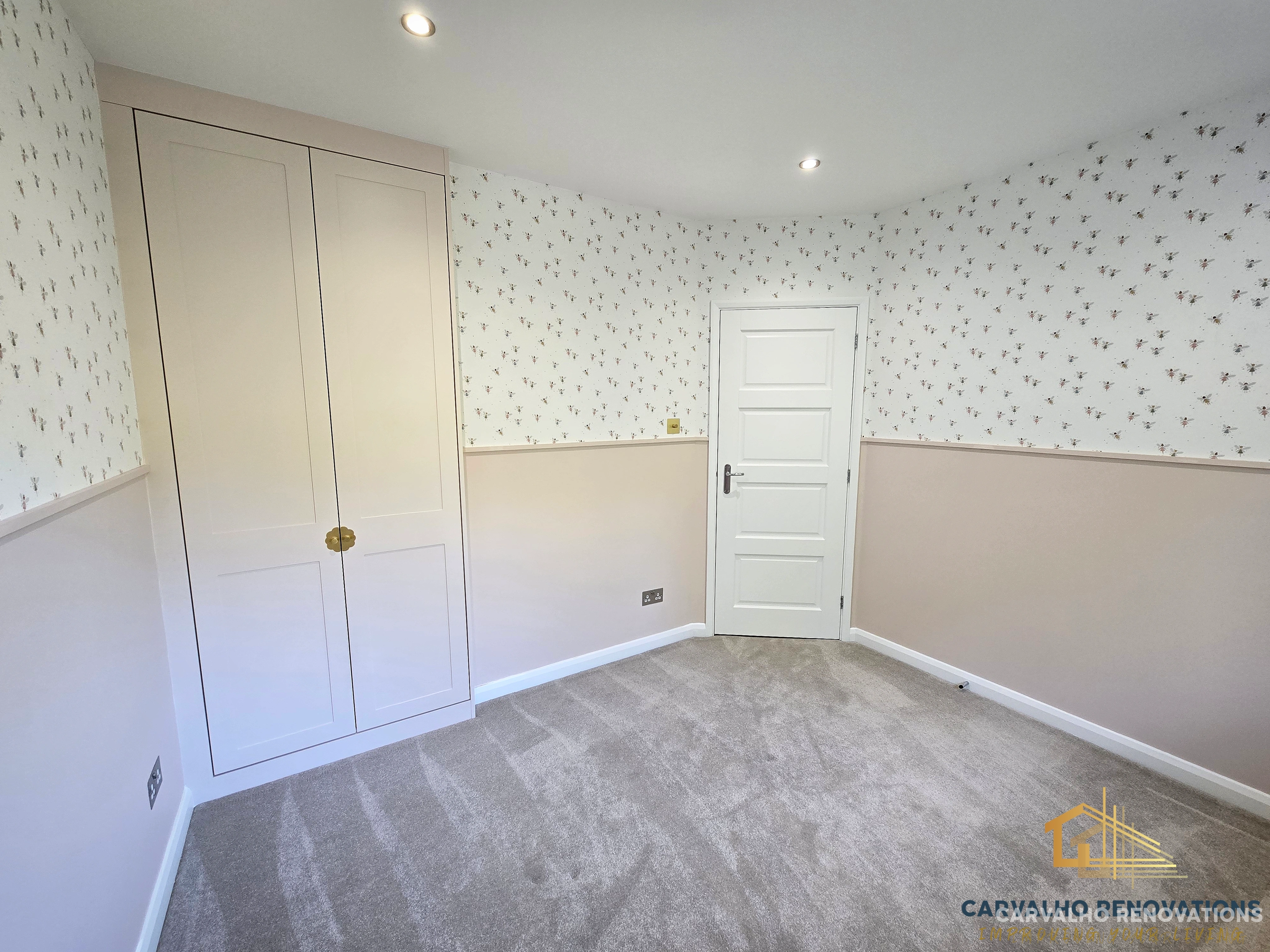
Most standard emulsion paints cover around 10-12m² per litre, per coat. Once you know your wall area and how many coats you need, working out how much to buy is simple maths — the bit most people get wrong is the coat count and the area measurement, not the coverage rate itself. This is the complete room-by-room version of that maths; if you just want the fast answer for one room, our quick paint quantity answer covers the core formula in under a minute.
The simple rule: coverage per litre
Wall area (m²) ÷ coverage rate (usually 10-12m² per litre) × number of coats = litres needed. Always round up to the nearest tin size, and buy from the same batch where possible to avoid subtle colour variation between tins.
How to measure a room for paint
Measure the perimeter of the room (add up all four wall lengths) and multiply by the wall height to get the total wall area. Then subtract roughly 2m² per standard door and 1.5m² per standard window — it's a small deduction, but on a small room it genuinely matters. Ceilings are measured separately: simply length × width of the floor area.
Worked examples: three real rooms
These use two coats of standard emulsion at 10m² per litre coverage (the more conservative end of the typical range, since real-world coverage is usually a little below the tin's headline figure):
- Small bathroom (2.4m × 1.8m, 2.4m ceiling height, one door, no window): perimeter 8.4m × height 2.4m = 20.2m² wall area, minus 2m² for the door = 18.2m². At 10m²/litre × 2 coats, that's roughly 3.6 litres — in practice, one 2.5-litre and one 1-litre tin, or a single 5-litre tin with some left over for touch-ups.
- Double bedroom (4m × 3.5m, 2.4m ceiling height, one door, one window): perimeter 15m × height 2.4m = 36m² wall area, minus 3.5m² for door and window = 32.5m². That's roughly 6.5 litres for two coats — typically two 2.5-litre tins plus a 1-litre, or one 5-litre and one 2.5-litre.
- Living room (5m × 4m, 2.4m ceiling height, one door, two windows): perimeter 18m × height 2.4m = 43.2m² wall area, minus 5m² for the door and windows = 38.2m². That's roughly 7.6 litres for two coats — commonly bought as two 5-litre tins, or a 5-litre plus a 2.5-litre.
These worked examples use standard proportions and won't match every room exactly — our Paint Calculator accounts for your exact dimensions, door/window count and coat number for a precise result.
How many coats do you actually need?
Painting over a similar colour
Two coats is standard, even when the new colour looks similar to the old one — a single coat almost always shows patchiness once it's dry.
Painting over a dark colour
Going from a dark or bold colour to a lighter one often needs three coats, or two coats over a dedicated stain-blocking/high-opacity undercoat, to avoid the old colour "ghosting" through.
New plaster or bare walls
New plaster needs a mist coat first (emulsion diluted roughly 10% with water) to seal the surface, followed by two full coats — three layers in total, even though only two are "proper" paint coats.
Ceilings
Two coats is standard for ceilings too. Ceiling paint is formulated to spatter less and often has a flatter finish than wall emulsion, so it's worth buying the dedicated product rather than using leftover wall paint. For the three worked rooms above, budget roughly an extra 1.5-3 litres of ceiling paint depending on floor area.
Choosing a finish by room, not just by colour
The sheen level matters as much as the colour, and different rooms genuinely call for different finishes:
- Matt emulsion — the standard choice for bedrooms and living rooms with lower everyday traffic; hides minor wall imperfections well but marks more easily and is harder to wipe clean.
- Eggshell or silk emulsion — a common choice for hallways, kitchens and bathrooms, where a wipeable, more moisture-resistant surface is genuinely useful; shows wall imperfections slightly more than matt.
- Kitchen and bathroom-specific emulsions — formulated with extra mould and moisture resistance, worth the modest price premium in a room that regularly gets steamy or splashed.
Trade paint vs retail/DIY-store paint
Trade paint (bought through a decorators' merchant rather than a general DIY shed) is usually formulated for better opacity and coverage per coat, meaning fewer coats and less wasted labour time — which is exactly why professional decorators use it. It typically costs more per tin, but the true cost per square metre painted is often similar or better once you account for needing fewer coats.
A simple buying checklist
- Measure and calculate per room, not for the whole house at once — rooms with different colours need separate totals anyway.
- Round every room up to the nearest tin size rather than trying to buy the exact litre count.
- Buy ceiling paint and wall paint separately, even if the colour looks similar off the shelf.
- Check the batch number on every tin of the same colour before you start.
- If in doubt on quantity, buy slightly over rather than under — an unopened tin is far easier to deal with than a mid-job trip back to the shop for a batch that may no longer be in stock.
Common mistakes that waste paint (and money)
- Buying based on room size in square metres of FLOOR area, not wall area — the two are rarely close
- Forgetting to deduct doors and windows on a small room
- Assuming one coat will be enough on a colour change
- Buying different batches of the same colour name — genuine batch variation is real and visible on a flat wall
- Skipping a mist coat on new plaster, then blaming the paint for patchy coverage
If you'd rather have the whole job quoted and done rather than working out quantities yourself, see our guide on painting and decorating costs.
Frequently asked questions
Related calculators
Related services
Related articles
How Much Paint Do I Need?
The simple maths for working out exactly how much paint to buy — real coverage rates, how many coats to budget for, and the mistakes that waste the most paint and money.
How Much Does It Cost to Paint a Room or House in the UK?
Professional painting and decorating cost depends far more on preparation than paint. Realistic UK costs per room, and what actually drives the price.
How Many Rolls of Wallpaper Do I Need?
The real trade formula for working out how many rolls of wallpaper you need — strips, pattern repeat, and why area-based estimates get it wrong.
Prefer to leave it to the professionals?
Whether it's one room or a whole house, our painting and decorating team can quote you a fixed price — no guesswork on paint quantities required.
Get a Painting Quote